☜ Proxy (part 1)
Understand the essence of AI/LLM
When I'm writing this, there is a huge push in the software industry toward using and trusting LLM-generated code and design. The most vocal supporters promise that the big opportunity created by LLM will empower developers and designers to create better products and do better services. On the opposite, the skeptics cry about losing accountability and care for the craft, pushing products and services toward mediocrity. The middle don't have a firm opinion, just keep silent and wait for the end result. This chaotic situation is the chance for opportunists to leverage for some gain, while the conservatives retreat to their safe zone and remind themselves and others about the old lessons in this industry. So to understand the nature of LLM and its implication is crucial for us to be able to move forward with confidence, with options and with peace of mind.
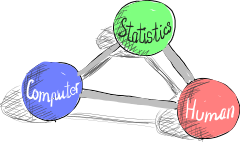
I've been looking at LLM and the surrounding situation for a while, got hands-on experience on LLM-generated code, even did a bit of assessment on its qualities to form an opinion on it. While LLM amazes me with what it can do, I am not surprised at all since I know how it works. For the layman, it is a combination of three main points:
It's point #3 that creates the chaos. No two people see the same cloud the same. Each uses their own interpretation to describe what the cloud looks like. To use the above metaphors, each person "generates" the words based on their "learned" knowledge. So point #3 is the human counterpart of #1 and #2, which the computer actually uses to mimic human behavior.
Things become interesting when the human factor comes into play. When a person looks at LLM-generated stuffs, they see something partly like their own creation, partly like no other. They know it's like a cloud, but it looks damn like a dog. How much it looks like a dog actually depends on the person — the majestic person looking at the thing will hear the words in their head that create their very own reality. Examples:
What one should also know, is that the thing is statistical (point #1) and humans play a part in interpreting it (point #3).
So we've understood the basic but main concepts about how LLM works. In the following parts, let's try using the three main points above to dive deeper into the technical, economical and social implications of LLM.
I've been looking at LLM and the surrounding situation for a while, got hands-on experience on LLM-generated code, even did a bit of assessment on its qualities to form an opinion on it. While LLM amazes me with what it can do, I am not surprised at all since I know how it works. For the layman, it is a combination of three main points:
- Statistics is a powerful tool to find relationships between concepts.
- The core of it is the representation of how related two concepts are by a single number. If two concepts are not very related, that number is small. Otherwise, it's big. Two words for the exact same concept have the highest possible number since they are the same thing.
- The computer is very fast at doing very simple things. Those, albeit simple things, are actually math operations like addition, subtraction, multiplication, division . . . which most people don't do often, thus the illusion that computers are smart things.
- The core of its power is repeatedly doing a "move" operation to move one thing to another place (in geek speak: move one bit to another memory location).
- Humans are creative, can imagine things not being there.
- Have you ever looked at the clouds and thought they looked like an animal? Our imagination is strong, it does this effortlessly.
- If you represent knowledge as text and feed it to a computer, it can calculate statistical numbers for every pair of words in that text. If the text is true, then the longer the text, the more "correct" the numbers reflect the relationship between the words in real life. If the text is not always true, people must change it manually (which we call "tuning"). This process is called "learning".
- When you have had the statistical numbers for the words, you can feed some initial words to the machine so it can find the word which has the highest statistical number for those initial words, then put that word after the initial words to form new initial words. The process then repeats. This process is called "generating".
It's point #3 that creates the chaos. No two people see the same cloud the same. Each uses their own interpretation to describe what the cloud looks like. To use the above metaphors, each person "generates" the words based on their "learned" knowledge. So point #3 is the human counterpart of #1 and #2, which the computer actually uses to mimic human behavior.
Things become interesting when the human factor comes into play. When a person looks at LLM-generated stuffs, they see something partly like their own creation, partly like no other. They know it's like a cloud, but it looks damn like a dog. How much it looks like a dog actually depends on the person — the majestic person looking at the thing will hear the words in their head that create their very own reality. Examples:
- When a business owner looks at it, the owner sees heaven since the closest words his mind generates are: cost, margin, leverage, acceptable, potential.
- When an engineer, developer or designer looks at it, she sees it as mildly interesting since her mind generates the words: how, potential, development, quality and dignity.
- When a manager looks at it, he sees: leverage, consistent, line up, cost, productivity.
What one should also know, is that the thing is statistical (point #1) and humans play a part in interpreting it (point #3).
So we've understood the basic but main concepts about how LLM works. In the following parts, let's try using the three main points above to dive deeper into the technical, economical and social implications of LLM.
--Vinh